
Exception tax on your team
Identify, decide which system is right, correct the record, update the customer, then hope it does not repeat.
NetSuite commerce architecture for IT and finance teams
Map where pricing, inventory, customers, and orders fall out of step—then decide whether to fix the connector stack, move commerce closer to NetSuite, or keep a deliberate hybrid.
30-minute working session. Walk away with a clearer read on connector vs architecture vs workflow—plus the Commerce Stack Friction Map worksheet.
Built for NetSuite-centred commerce decisions where operational fit matters more than another storefront pitch.

Map your stack before the next exception hits.
Book a Discovery CallFree 30-min session · No obligation · Worksheet included
Teams that have worked with LST Consultancy








Problem recognition
The storefront says an item is available. NetSuite says it is not.
A customer logs in and sees the wrong price, terms, catalogue, or account detail.
An order appears online but needs human correction before operations can trust it.
The integration queue is “healthy,” yet finance, customer service, or the warehouse is still working an exception.
When this happens, the real integration layer is not software. It is the people checking, retrying, reconciling, and explaining.
And the problem tends to surface at the worst moments: after order volume grows, during a platform change, when a new leader reviews the stack, or when another edge case is added to an integration that was meant to be simple.
If this sounds like your stack, a 30-minute discovery call is the fastest way to separate connector debt from an architecture mismatch.
Book a Discovery CallThe cost of the current situation
Four places the same mismatch keeps taxing the organisation.
Identify, decide which system is right, correct the record, update the customer, then hope it does not repeat.
Wrong price, availability, or order status sends buyers back to email and phone.
Each system can be “working” while the order flow still fails. Ownership becomes a meeting.
Diverging customer, price, tax, or payment states must be reconciled before anyone can report with confidence.
How SuiteCommerce Advanced and LST address the problem
SuiteCommerce Advanced can bring the customer-facing commerce layer onto NetSuite’s customer, item, price, inventory, order, and account logic. That can remove entire categories of storefront-to-ERP synchronisation where the use case fits. But “native” does not mean “nothing else to integrate,” and it does not excuse poor storefront, data, extension, or operational design.
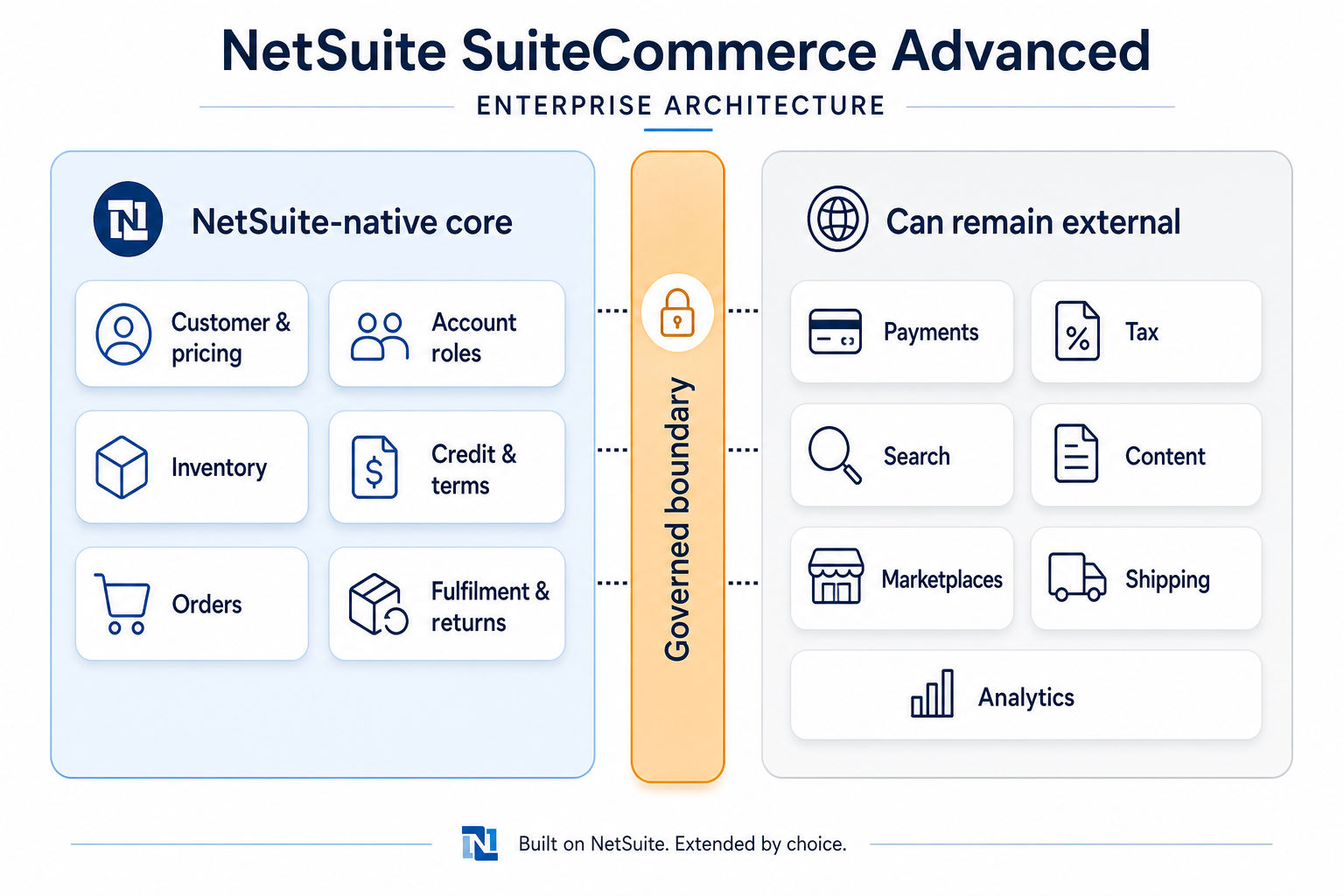
Must be NetSuite-native
Cannot tolerate delay or ambiguity
Can remain external
Deliberate boundaries, not zero integration
LST’s role is to help answer the questions a platform comparison usually skips:
Identify the records and rules that cannot tolerate delay or ambiguity: customer-specific pricing, account roles, inventory availability, credit/terms, orders, fulfilment states, returns, or other business-specific logic.
Payments, tax, search, content, marketplaces, shipping, analytics, and other services may still need deliberate boundaries. The goal is fewer avoidable dependencies and clearer ownership—not a fictional “zero-integration” stack.
Compare SCA, SuiteCommerce Standard, an external storefront with better-defined integration, and hybrid approaches against actual workflow—not a generic feature list.
Define extension boundaries, testing, releases, documentation, and support ownership before code becomes institutional memory.
LST’s implementation approach
Document the storefront, NetSuite, middleware, custom scripts, applications, data owners, schedules, and exception queues.
Follow representative flows from login and price lookup through inventory, checkout, order creation, fulfilment, returns, and reporting. Include the edge cases teams currently handle by memory.
Score the viable options against data criticality, B2B complexity, buyer experience, maintainability, governance, and operating ownership.
Define record ownership, integration boundaries, extension patterns, acceptance criteria, and proof requirements.
Validate with IT, finance, commerce, customer service, and operations—not only the project team. Rollout and support specifics depend on scope and are agreed in the engagement.
Business outcomes to design for
These are the outcomes an architecture decision should be designed toward—not a guarantee attached to any single engagement.
Relevant use cases
Why LST Consultancy
The reason to involve LST is the method:
LST specialises in SuiteCommerce Advanced for distribution and manufacturing teams where pricing, inventory, and order logic cannot tolerate sync delay. Engagements start with stack mapping and ownership clarity—not a storefront pitch.
Certifications





Straight answers
Sometimes that is the correct answer. If the external storefront is a strong fit and the failures come from unclear ownership, poor mappings, or under-designed edge cases, rebuilding everything may add risk without removing the root cause. The Friction Map is designed to separate repairable integration debt from a structural architecture mismatch.
Because native data is only one decision factor. If your primary need is consumer UX velocity, a broad app ecosystem, or a modern composable engineering model, SCA may not be the best front end. LST recommends it only when NetSuite-centred operational complexity justifies the trade-off.
No. Most commerce environments still use external services. The relevant question is which data and decisions must be native, which can be external, and how failure is contained.
It can. A storefront cannot compensate indefinitely for inconsistent items, customers, prices, roles, or fulfilment rules. Data readiness belongs in the architecture and implementation plan.
Require documented extension boundaries, release practices, testing, ownership, and upgrade review as part of the solution—not as post-launch cleanup.
Still weighing connector repair vs replatform? A discovery call is the fastest way to get a straight answer.
Book a Discovery CallNext step
In 30 minutes, map where your storefront and NetSuite fall out of step—and decide whether to fix the connector, move commerce closer to NetSuite, or keep a deliberate hybrid.
You will also receive the Commerce Stack Friction Map worksheet to capture:
Pick a time that works for you. You’ll receive a calendar confirmation by email.
No obligation. Your details are used only to schedule the call and deliver the worksheet. Privacy policy
Frequently asked questions
SCA is NetSuite’s customisable commerce tier with front-end code access and direct use of NetSuite commerce/ERP records and logic. It differs from the more configuration-led SuiteCommerce Standard.
No. Fit depends on B2B complexity, data criticality, customer experience requirements, customisation needs, operating ownership, and long-term maintainability.
That is the intended posture of the diagnostic. LST can review your current integration and recommend repair, better-defined boundaries, or a replatform—based on what the stack actually needs.
Usually customer/account, item/catalogue, pricing/terms, inventory/availability, order, fulfilment, payment, returns, and reporting states. The priority depends on where exceptions occur.
Treat data readiness as a workstream. Define owners, cleanup rules, acceptable exceptions, and staged scope before exposing unreliable data to customers.
It may remove some storefront-to-NetSuite synchronisation, but external services and integrations can remain. Any cost conclusion requires a company-specific stack analysis.
Compare real workflows and dependencies: account pricing, inventory, order edge cases, buyer UX, marketing needs, release governance, support ownership, and total operating inputs.
It depends on systems, sites, subsidiaries, data, customisations, workflows, and stakeholder availability. LST validates scope before offering any timeline.
No pricing is fixed in advance. LST publishes pricing or a scoping method only after confirming what is included and how change is handled.
You’ll receive a calendar confirmation by email with the meeting link. On the call, LST walks through your stack friction points and helps you decide whether the problem is the connector, the architecture, or the workflow around both. You’ll also receive the Commerce Stack Friction Map worksheet to use internally.
Map the stack before you fund another patch or another replatform.
Book a Discovery Call30-minute working session. No obligation. Worksheet included whether or not you engage LST afterward.